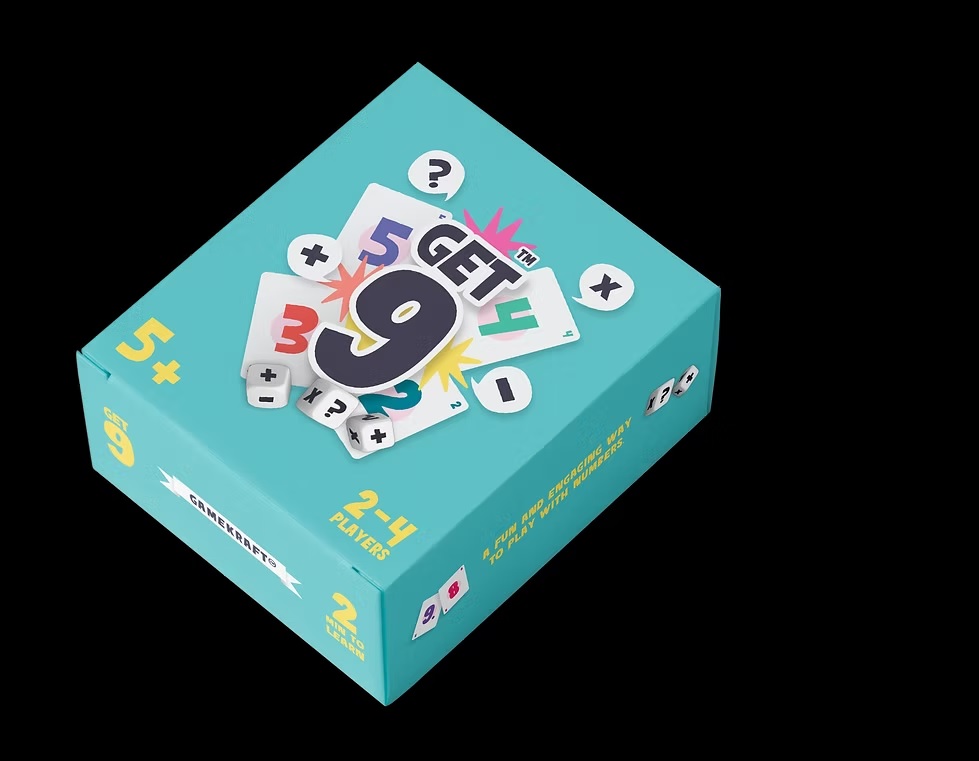
| Publisher | GameKraft |
| Design Credit | Jacquie Carroll |
| Game Contents | 78 cards (six sets of 0 through 12), four dice (two easy, two hard), rules |
| Guidelines | Competitive number-crunching card game |
| MSRP | $24.99 |
| Reviewer | Andy Vetromile |
Once upon a time there was King of 20, a Scrabble-style board game in which players created an interlocking crossword – crossnumber – in pursuit of 20. The further you strayed from this golden digit the worse off you were. GameKraft introduces Get 9, a card-based quest for equations that leave off at 9, only here it’s 9 or nothing. Where these numerals get their magic, how the designers settle on their chosen talismans for these games, is anyone’s guess.
The object is to amass the most cards.
Two to four students of the mystic art of math each get a very public hand of cards. With possibilities numbered 0 through 12 they sit faceup in front of each person. Two dice are thrown into this mix, and the start player tosses them. The dice show arithmetic operators – plus, minus, times, and divided – as well as blanks and question marks. Now the trick is getting any and all of this to amount to a result of 9. The ways this can happen are dizzying.
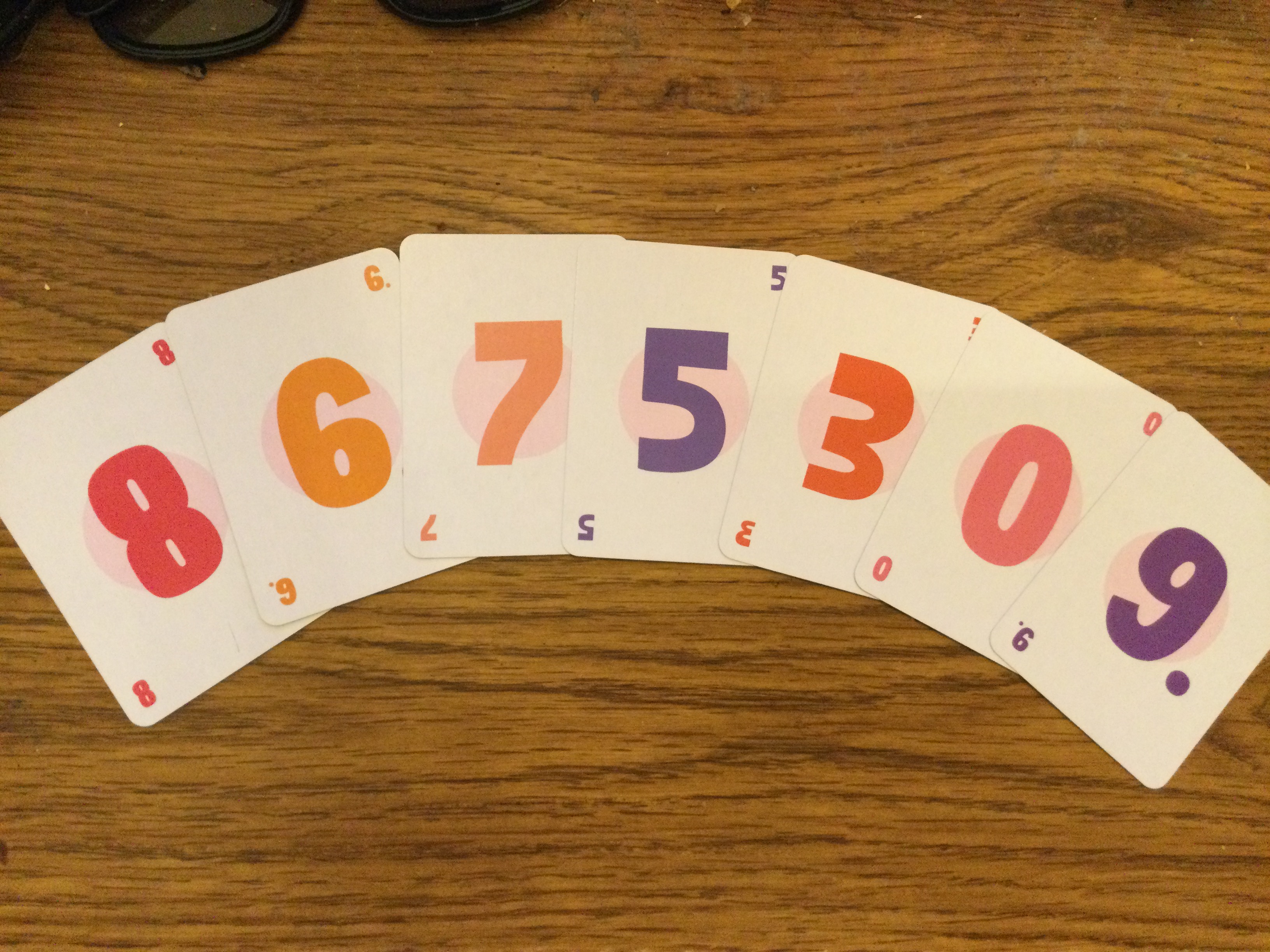
A random sampling of . . . hold on, Jenny has joined the chat.
The easy thing is to take two cards, put a die between them, and come up with 9. A 3 and a 6 with a + showing between them does just fine, as do a 10 and a 1 with a minus inserted. Since you want to get rid of as many cards as possible in short order, the more you use, the better you do. 5 + 2 + 2 accomplishes the same thing only now you get to add three cards to your success-laden “calculation pile.” Multipliers and dividers let you get really fancy, given the rules say you can combine elements in your hand to make all manner of exotic arrangements. You could place a 2 next to a 1, call it 21, place a minus die, and drop another 1 and 2 to make 12. Voila, another 9. Things get truly hairy with cross sums, because Get 9 allows you to multiply six by six and claim the 36 “adds” up to 9 (so not only are you placing cards together to form new amounts your results, taken as understood even when not visible, can also spiral off into answers). Once someone has emptied their hand, or the draw deck is itself depleted, the game is over and whoever has the most cards in their calculation pile wins.
Robust is the best way to describe the included parts. It’s hard to do lousy dice, and they’re almost clean and clear as far as the symbology goes. Your sight distance to the table and your personal visual acuity might give lie to that estimation, what with pluses and multipliers, question marks and division symbols, but short of color-coding the sides there’s not much else to be done to bring everything into perfect focus. The four cubes are divided into the easy and hard dice, meaning those with and those without multiplication and division operators. So that brings you to the cards. These are easily some of the best quality in many a game of late. They’re full and firm and while that makes them tougher to shuffle back-side-up (number side up is a good deal easier to work with – why does that always seem to be the case with games these days?), it does spell (enumerate?) a quality product. No, where Get 9 falls short of the mark is its rules. It’s just a sheet that folds out and it leaves too much unsaid or poorly described. By way of examples:
Describing blanks, it says “the player will have to skip a turn with that dice throw.” Does that mean skip one’s entire turn or just don’t use a die that comes up blank? “…a combination that ends in 9” (not “results” in a 9). That kind of ambiguity is slight but not insignificant (19 ends in 9, after all), especially in a game where you just know the math geeks will find a way to argue over the absolute values of their outcomes (“It doesn’t say negative 9s don’t count”). The rules at first speak of making an equation but by the end suddenly it sounds like you can make two. Most of the instructions can be puzzled out (or house-ruled) but greater clarity and some language tweaks would not be unwelcome.
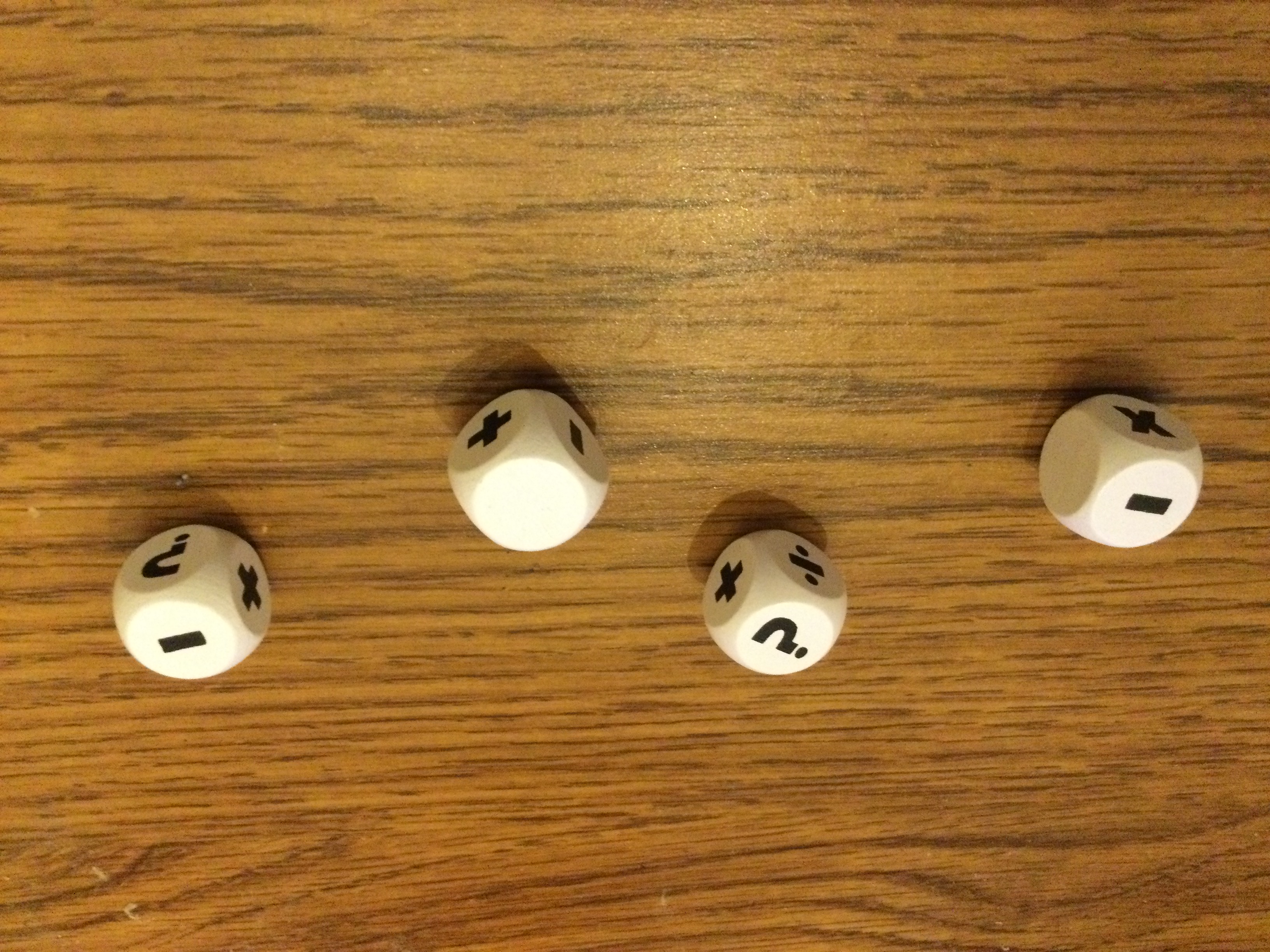
We have to operate or he’ll die.
Get 9 isn’t fuzzy at the edges of every rule; sometimes it outright makes you groan a bit inside once you realize how freeform some of this comes across. One wrinkle they add is the steal. If you cannot come up with a formula for a 9 but someone else sees something you missed in your own card/dice options, they may lay their hands on the dice and, using all the tools you had available, point out a mistake and take the credit and the cards. Good idea in theory but in practice it might break down or extend the game past its suggested 20 minute play mark. Even if you used one die they can point out there was a way to employ the other, along with additional cards. More ill-defined material: “If the steal is successful” . . . and if it wasn’t? Without penalties someone will just yell and grab dice to be first to try even if they fall short. “A successful steal lets the player add all cards, including the first one used”. First one? That’s vague to say the least.
Problem is, this could go on a while and there seems to be no end to it. Arrange the numbers every possible way to determine the absolute best thing you think you can come up with, and even then if someone else sees an extended opportunity they might just steal your hard work with one small improvement. It’s a little like working out pi to 100 decimal places only to have someone else add a 101st digit and take all the credit. It encourages long reexaminations by the other participants and that in turn means one takes longer turns to head off being stolen from in the first place.
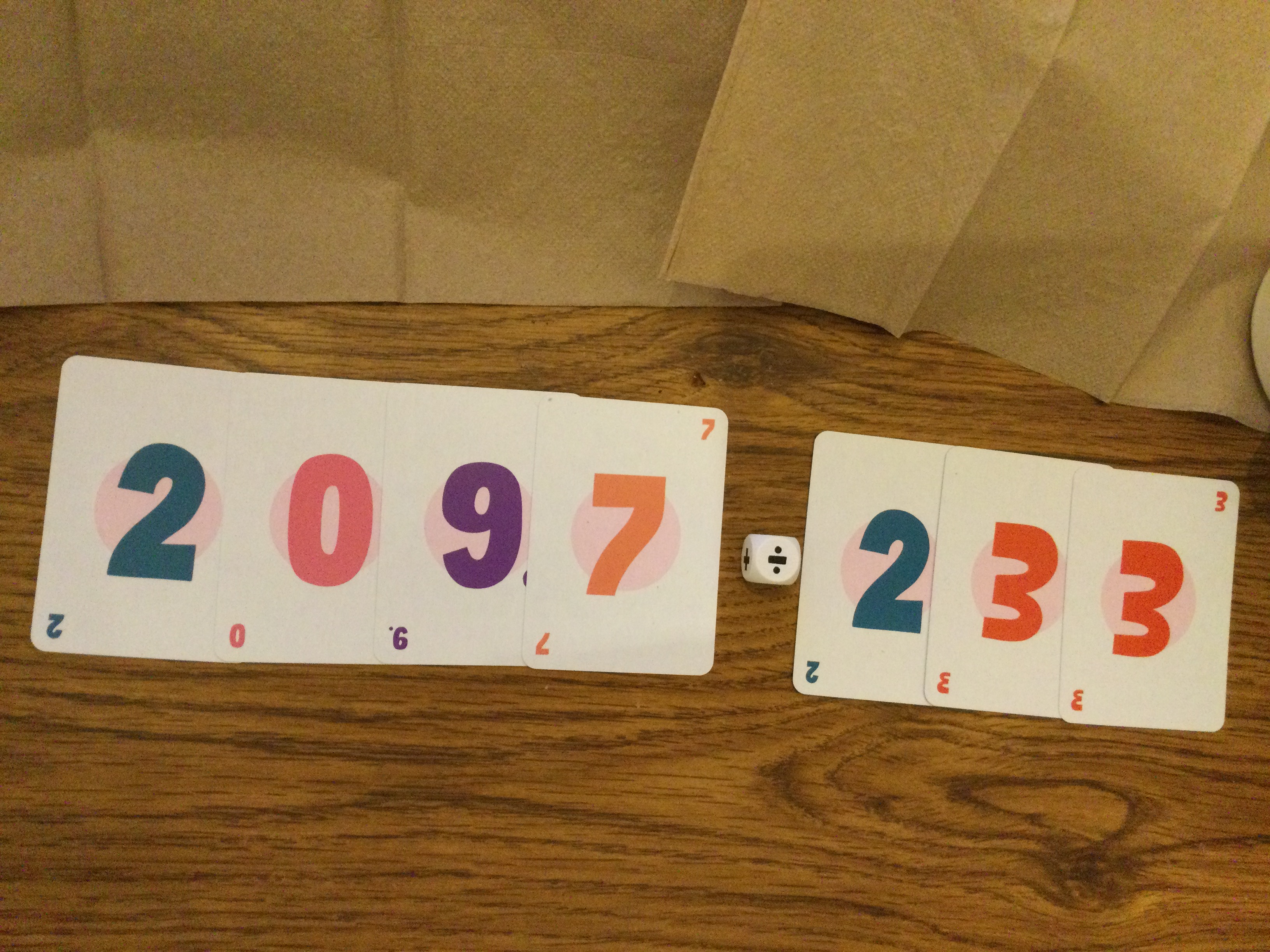
Fifteen minutes later, easy-peasy, lemon squeezy.
Keep in mind this is intended primarily for learning opportunities and family get-togethers; serious adult competitors with something to prove are a secondary consideration. Get 9 isn’t going to show itself out in head-spinning higher math for every group that picks it up. It’s understandable, adding the steal mechanic to spice up the action a little, and nothing says the players aren’t allowed to ditch those rules or drag out the chess timer. The active player isn’t the only one looking at a hundred combinations to max out his score. Everyone is essentially playing every hand and looking for that advantage the rest missed. (Whether the members harbor any ill will outside the mechanics, brought about by a “gotcha” rule, is obviously something they can work out for themselves.) The strange panoply makes for what is admittedly a compelling and intriguing flow of play – “There has to be an even better answer” – but buyers should go into Get 9 forewarned math class never was this interesting . . . nor felt this long.
