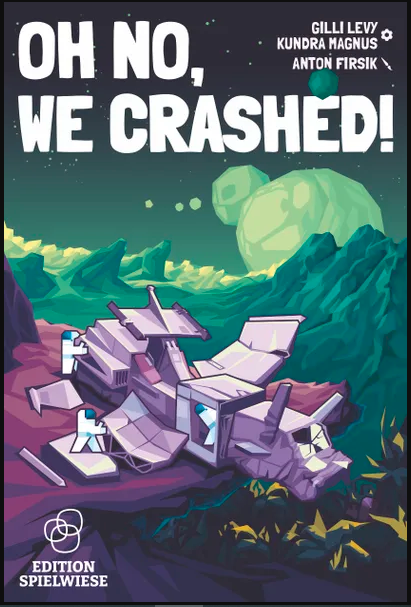
| Publisher | Edition SpielWiese, Hachette Boardgames |
| Design Credits | Gilli Levy, Kundra Magus |
| Art Credits | Anton Firsik, Fiore GmbH |
| Editing Credit | Cyrill Callenius |
| Translation Credit | Ralph H. Anderson |
| Game Contents | Spaceship standee, 110 cards, Hitchhiker’s Handbook, rules (timer not included) |
| Guidelines | Timed cooperative spaceship repair game |
| MSRP | $14.99 |
| Reviewer | Andy Vetromile |
If it sounds too good to be true, as they say, it probably is, especially in matters of on-the-cheap spaceships meant to ferry you among the stars. Should someone offer to peddle you a craft like this, check their references and see if they have a seller’s history you can look back at (and count on). Otherwise you, too, may lament Oh No, We Crashed!
The object is to effect repairs on your ship to get oxygen flowing again. Then nothing else can possibly go wrong.
Three to six members of a crew in a questionable spaceship surround a standee representing their transportation, set in the middle of the table. Around this, a close circle of eight System cards showing all the damage keeping the crew grounded and gasping. At an even further remove is a bigger swath of face-down spare parts, Components, they might or might not need. Someone pulls out a Timer and the fun – if you can call the act of trying to stay alive on an alien planet “fun” – begins. Each player may pick up one or two of the bits and bobs on the table to see what they are but only two at a time because that’s how many hands a human has. If he doesn’t like what he finds he can set it down but while it is now faceup it must go back to roughly where it was; no arranging them into convenient piles or areas.
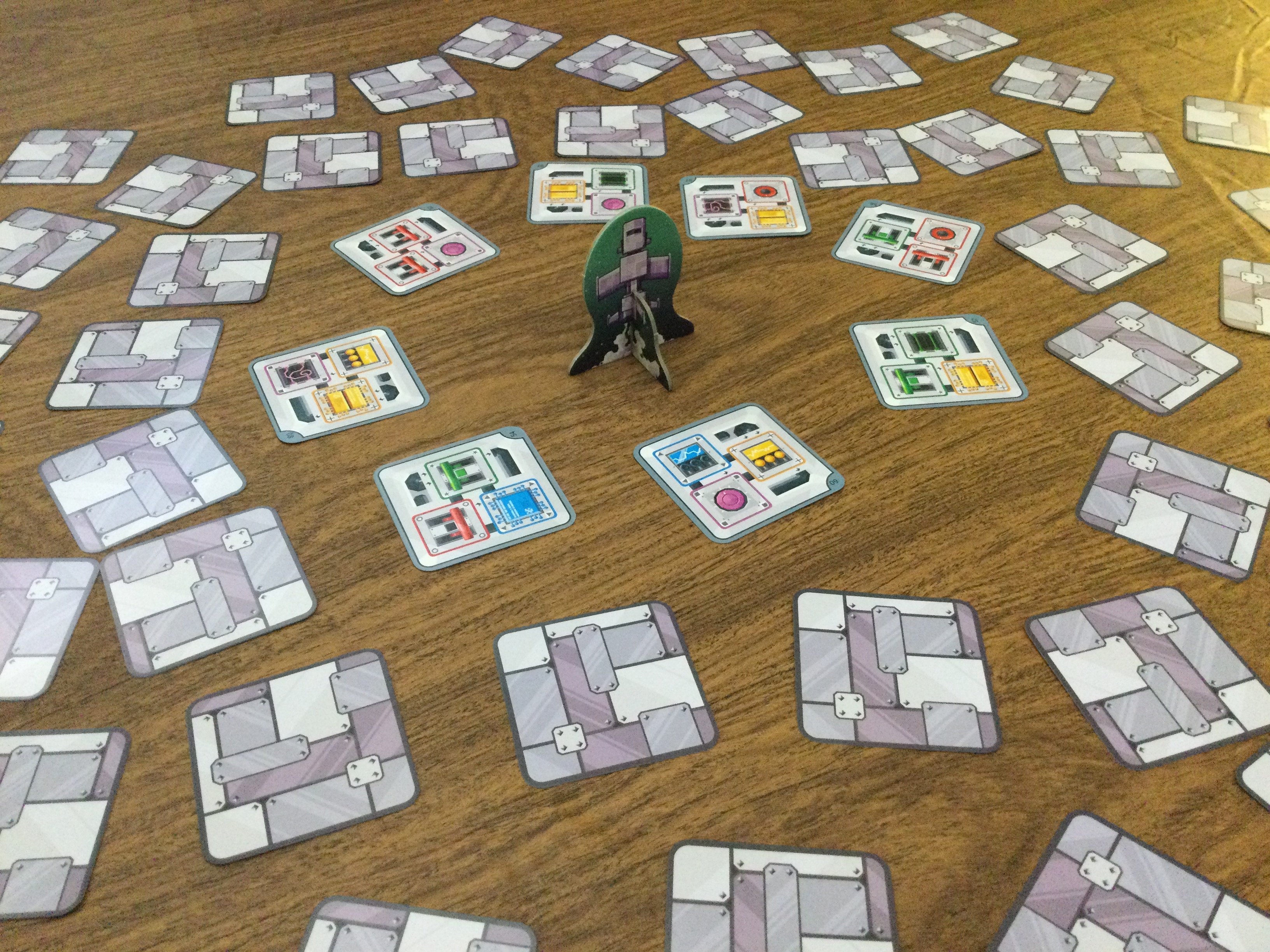
Yeah, this oughta be a breeze
These pieces match the ones pictured on the System cards; each of those demands three Components to repair. That means it takes two or three people in cooperation to gather the right items, which they place on that damaged square. Flip the completed stack down to show it’s been dealt with and one-eighth of your problems are over. Get the other seven-eighths into the engineering bay (or wherever this is happening – could be the bathroom for all anyone knows) and the ship and its occupants are saved. The refreshed craft proudly takes flight and promptly crashes into the next available planet on the itinerary, carrying you over to a new mission.
It’s a simple set of, well, components: a Starship standee in the middle and dozens of cards surrounding it (okay, it doesn’t look so simple scattered around your dining room table and even less so when the clock begins taunting you). In the box, more cards for more missions. They seem pretty thin (stock, that is, not the narratives behind the missions, though why this vessel is still spaceborn . . . look, never mind) but hopefully they won’t get much wear and tear since they’re only handled long enough to pick them up and deposit them on the System in trouble. They are a bit slick so keeping hold of them is sometimes a problem – shuffle with care – but they’re colorful and easy on the eyes. That doesn’t mean they’re completely clear: There are two cards of every color, leading to some confusion which one you want for which repair, but that little breath of misdirection is precisely the point. They have the now-traditional symbology in the corners for the benefit of those with color-blindness; how effective they are and how easy it is to learn all the various shapes is an exercise left for the user. In this day and age of cell phones there’s little chance of not having a stopwatch originating from some quarter (games run about one to three minutes) and the variations-by-objective change the durations so a sand timer isn’t the answer, but there does not appear to be a BYOT warning on the box even though the text mentions “the timer is running out!” It feels like the mission descriptors in the Hitchhiker’s Handbook could be a bit smoother, but they mostly miss the worst mistakes when translating from the (presumably German) original version (and yes, this is one of those games where most elements are capitalized, and those, well – unevenly).
Oh No, We Crashed! runs for 10 or more missions (plus the tutorial – after a while you have to wonder if it’s worth it to leave the planet and maybe just settle on the one you’re on rather than duct-tape this benighted heap back together again). Depending on the group’s tastes this could be one fairly full evening or several quick games over the course of several sessions. It’s not a lot of material to work with but it knows how to hit you where it counts. Got a strategy worked out? Rest assured it won’t, as they claim von Moltke said, survive contact with the enemy. You can rapidly flip over all the cards you want to get that task out of the way . . . until night falls and you’re required to put them back facedown. Interventions by forces both animate and inanimate will deny the convenient use of some facets of gameplay, and chances are you’re not going to get it right the first time anyway. Suggestions at the back of the handbook hint how to extend the life of your purchase even further with combinations of obstacles and conditions. It’s certainly reasonably priced compared to the vast array of card games calling out for your galactic credits (and an expansion, while not necessary, would be both welcome and probably not too hard to pull off).
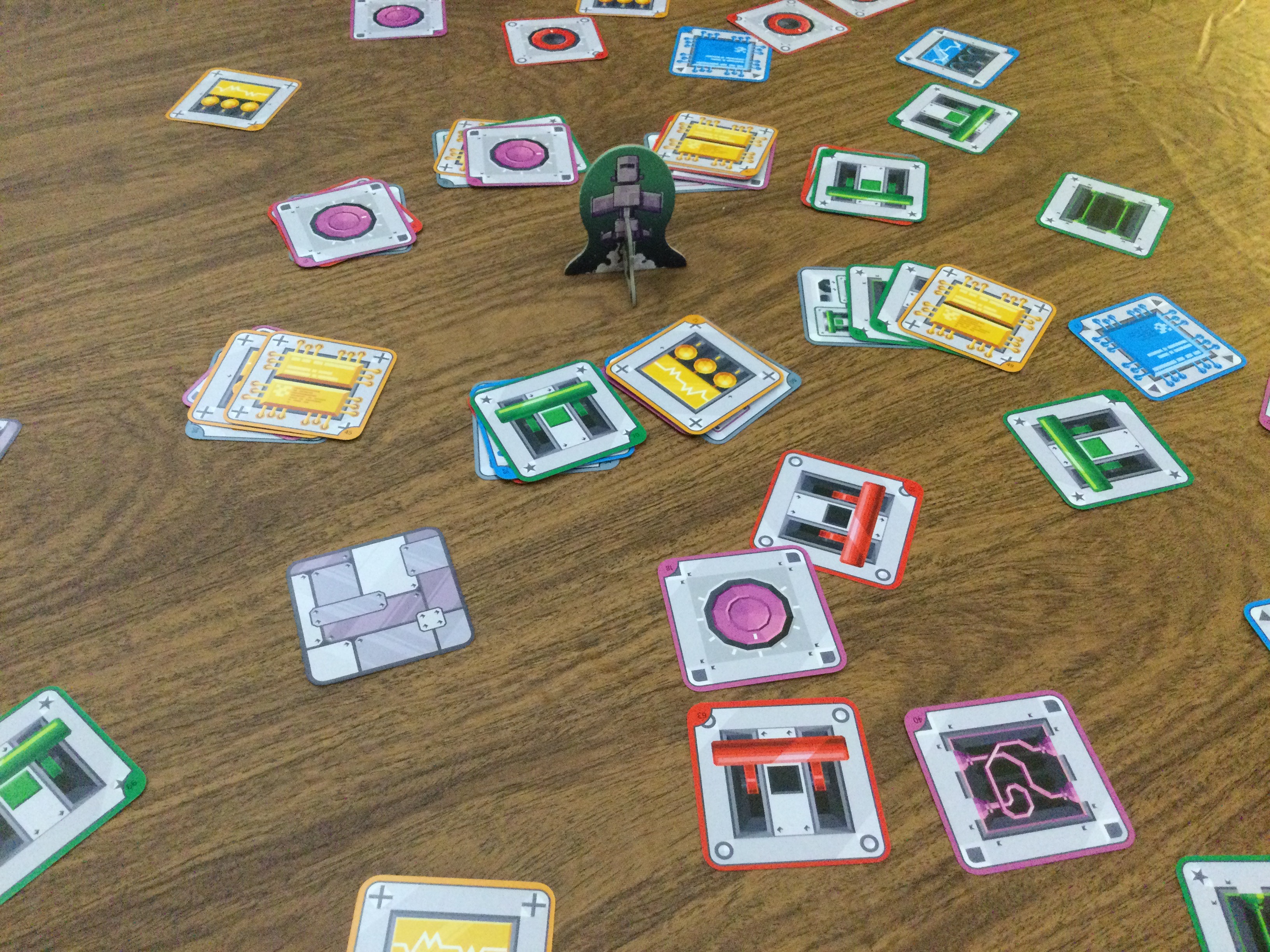
And with all the cards assigned properly – you . . .DID assign all the cards properly, yes?
Re-sorting the cards is a bit tricky; it’s not hard to do since the deck is numbered but it does mean if you want to get it to the table on successive nights with different groups you have to do some recounting and reordering at the end of the evening (or over lunch – hey, your damaged ship isn’t going anywhere, it’s not like you have anything better to do). You can easily see how the strategies change as you get deeper into the action, but later missions also give rise to questions not adequately explained. At least one task asks for some reshuffling of cards but no mention is made of whether to pause the clock, and you’re already under crushing time pressure. Another speaks of “discards” without specifying what it means to do so; there are plenty of Components for the missions but time is already the enemy so not knowing whether you even have materials enough to finish what you’re doing could spell predetermined disaster. Not only are there cards with similar colors but different designs; to keep you on your toes about whether you have the correct style of blue piece, you’re going to want to develop your own shorthand for what to call some of these Components. By the time you say “I need a blue card with the little E.R.-style squiggle waves on the readout” the ship has become an airless tomb.
In spite of the slightly thinned cards and a few nits in the rules, Oh No, We Crashed! is a fits-in-your-pocket factory of fun and frustration that won’t break the bank. The spirits of the players, sure, but there’s a whole lot of game in this unassuming box, and imagining your efforts result in a slam-dunk is going to get you killed. Families should, as advertised, enjoy it – it may even teach the younger set pattern recognition, spatial reasoning, or some other developmental buzz-phrase – and everyone soon gets up to speed with each other. All of this might sound like you’re being sold a bill of goods – small, smart, inexpensive, and engaging – but unlike your Spaceship even what sounds too good to be true about Oh No, We Crashed! is true.
