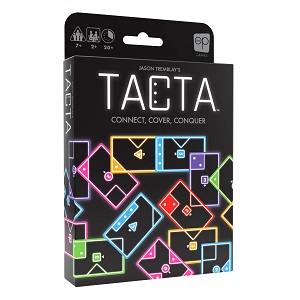
| Publisher | The Op |
| Design Credits | Jason Tremblay |
| Game Contents | 109 cards (one start card and six 18-card player decks in six colors), rules |
| Guidelines | Abstract pip-scoring, shape-sorting furor |
| MSRP | $7.95 |
| Reviewer | Andy Vetromile |
Some games don’t even bother with a theme. Some of them tack it on like they just don’t care, or because they think they can market it, or who knows what. Then there are entries like Tacta that you have to admit once you get started really don’t need or benefit from any sort of motif, you just have to jump in and go.
The object is usually to score the most points. More as it develops.
Two to six players each get a deck of 18 cards to serve as their hand. Save for elements like the color and the symbol – the little notation that allows colorblind people to distinguish the hues – everyone gets the same selection. Into the center, a starting card, covered with spaces to launch your efforts. The cards are decorated with shapes to dictate play and pips to determine scoring, and they’re double-sided so each has a mirror-image on the opposing face. After shuffling you can now see the available selections on either “end” of the deck.
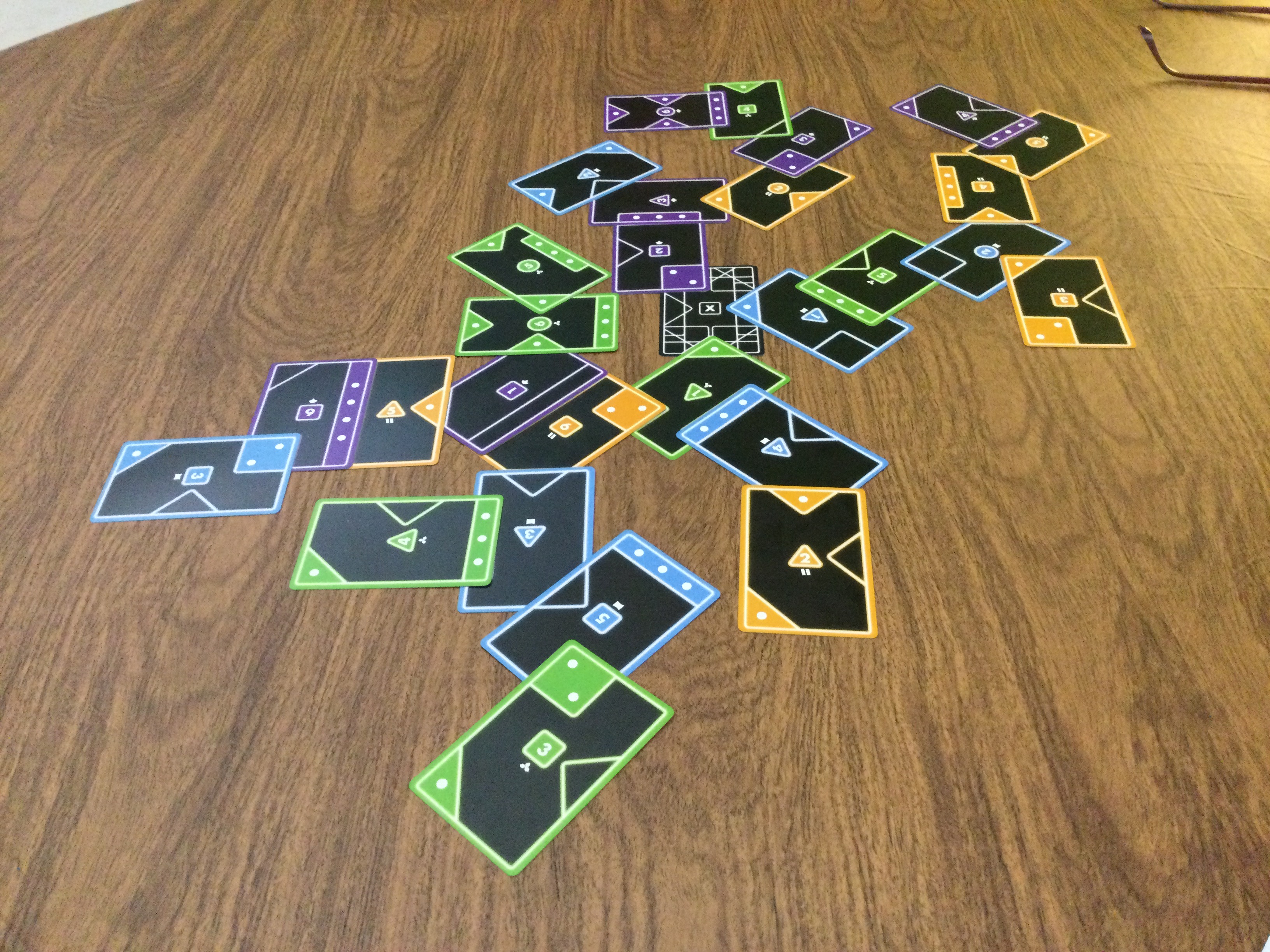
From humble beginnings…
On their turn a player takes one of these outermost cards and plays it. He has to cover one of the corners or edges of the start card, or of another card that has in turn been played on that. As things progress an octopus of cards forms, sprawling across the playing surface in tortured proliferation. This allows one to drop pips onto the display or, if one is tired of having so darn many friends, cover an opponent’s dots with a field that fits but is empty. Truly depraved individuals cover their foes’ advances with their own pips in the same move. This continues until everyone has alienated everybody else at the table and run out the contents of their deck, at which point any still-visible dots are counted and the spatial reasoning genius with the most wins.
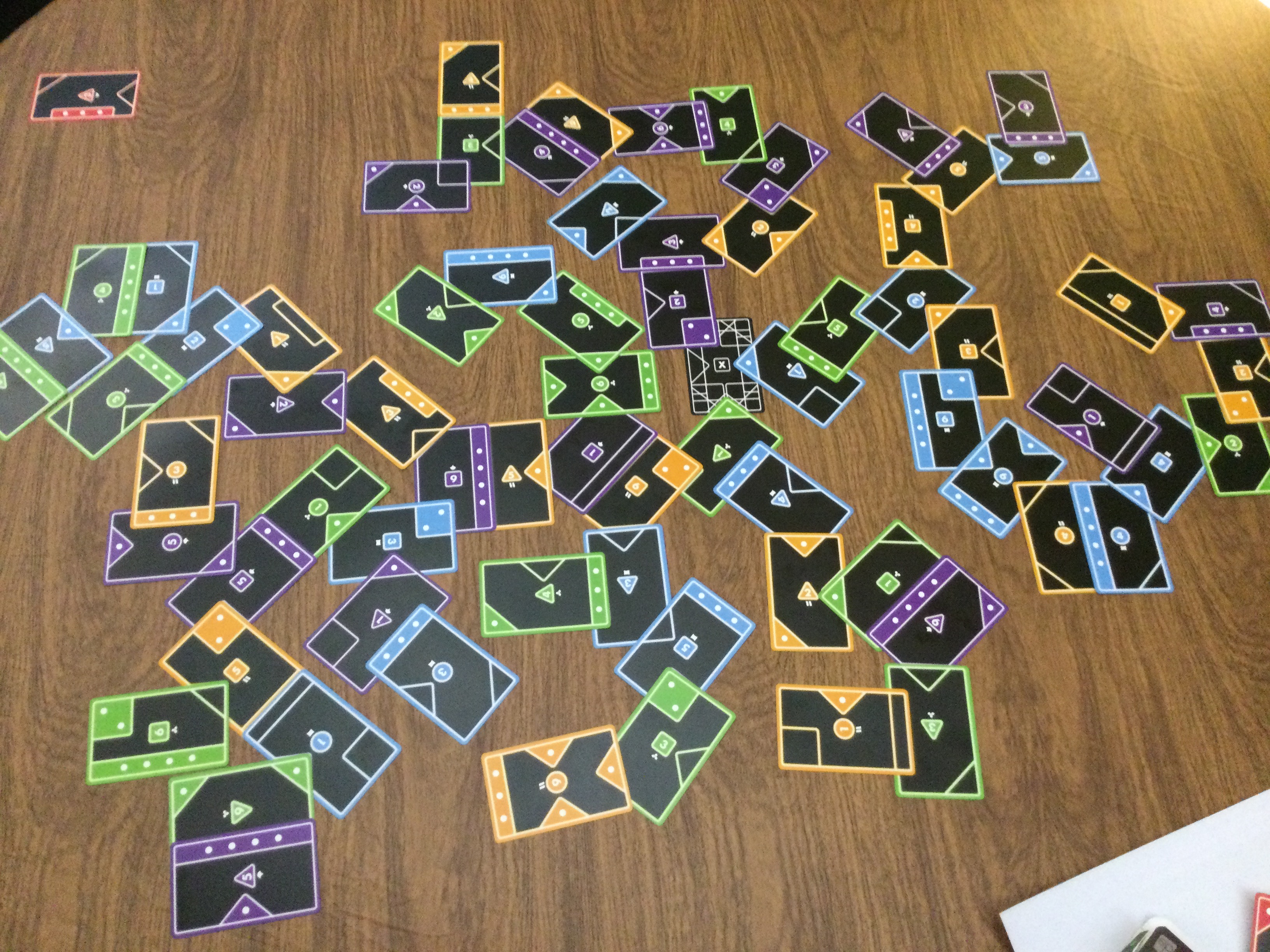
But they grow, people…they grow
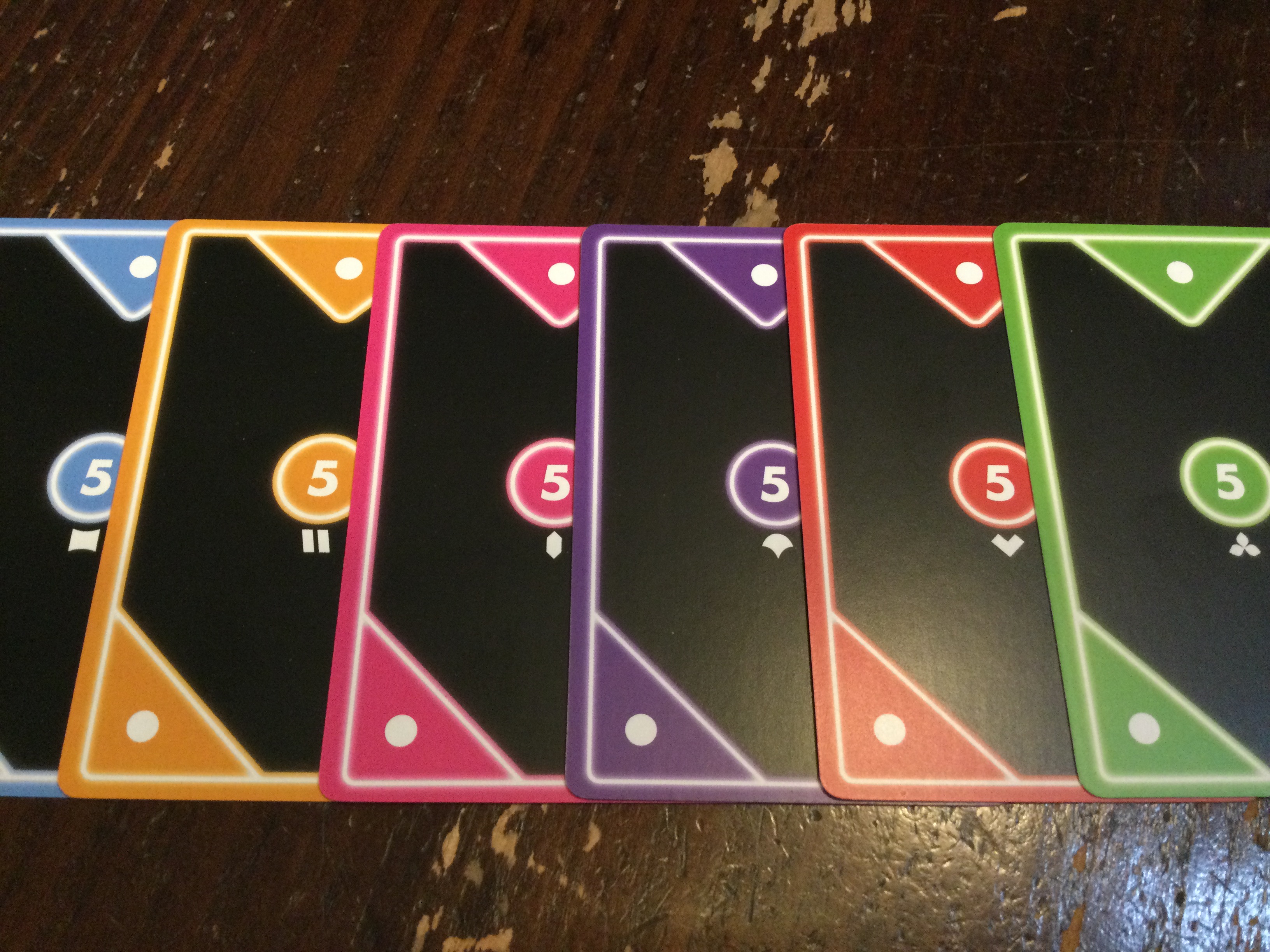
Tacta’s box contains 109 cards and a set of rules (and in all likelihood a little catalog), with one start card that looks like a map of the London Underground only not as simple. The remaining 108 are divvied up into six decks for as many players. They’re pretty colorful though there are some that are a bit too close in hue to one another. That’s why they’re also distinguished by small symbols – squishy hourglasses, parallel lines, tiny arrowheads – denoting which cards belong to which player, though again, they’re not always successful at this since a couple favor each other a bit (and you’re presumably meant to be able to distinguish them from a table’s width). There’s a promo pack floating about that provides another pair of colors, allowing you to play two-player games or combine with the base set to engage in eight-person shenanigans. Given how much work these have to accomplish it’s still rather an impressive feat for them to be as distinct and eye-catching as they are.
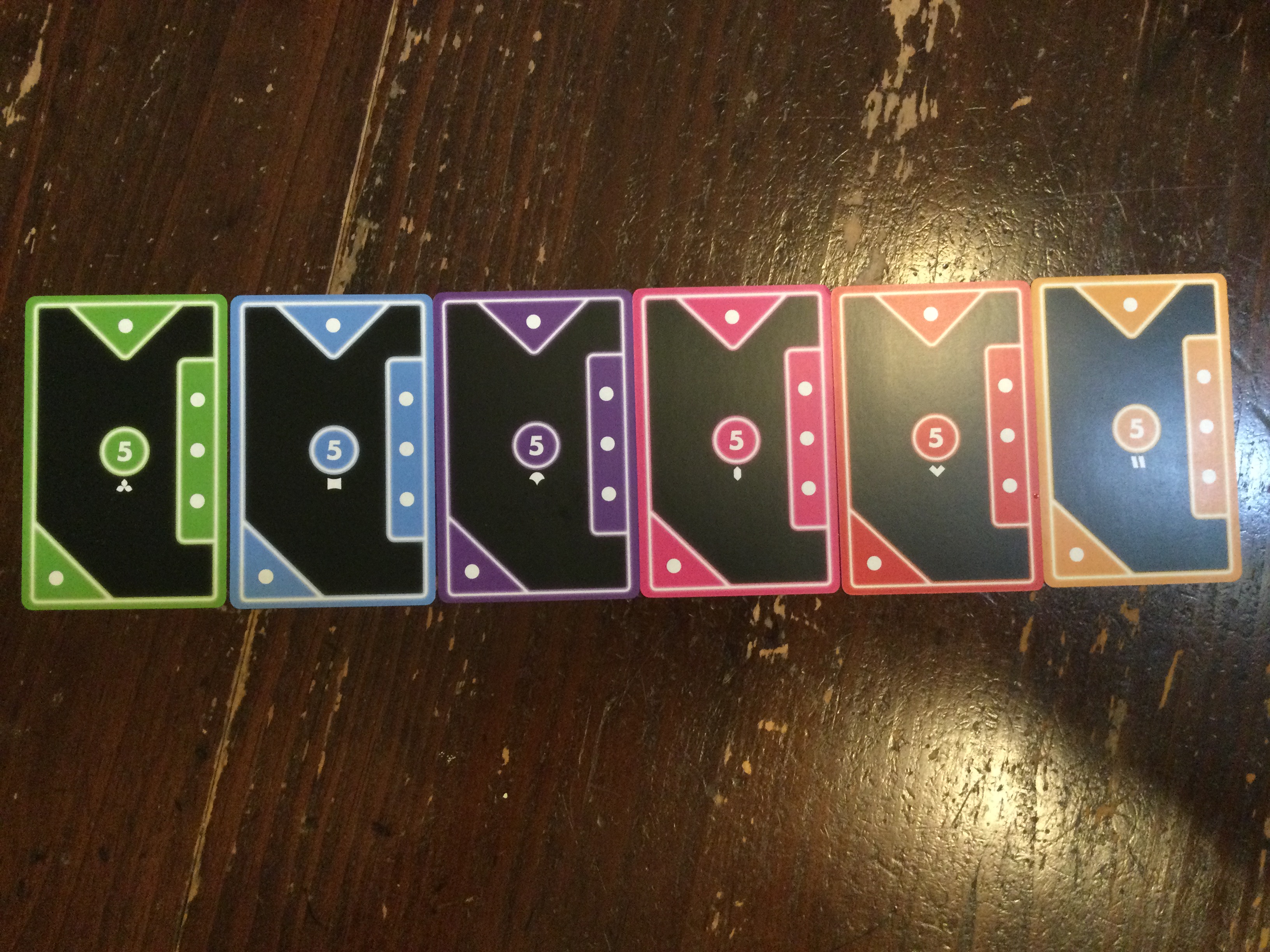
A rainbow of flavors…that begin to bleed into one another
It’s rare to find this much strategy and so much game in a simple deck of cards but Tacta pulls it off deftly. Kids will love the colors and shapes and making connections while the adults have to admire the beauty of the display and appreciate the depth – and breadth – of possibilities (and, yes, the joy of making connections) in a tight and sharp little package. Sure, it’s dizzying, but it’s also the right kind of challenging. There’s more than one way to play and the rules offer up almost half a dozen variations from team play to card drafting. You’re encouraged to innovate as well since the shapes at the center of the cards serve as “suits,” giving all of them several elements to play jiggery-pokery with.
You were warned
The game gets longer as the options increase, with cards blowing up in all directions, and without a chess timer of some sort it makes a lie out of the box’s claim of a 20-minute pastime. You score between 30 and 50 points per full hand so be aware if you take the company up on its suggestion of a longer game that can mean an all-afternoon affair. Their ways to shorten things rather than extend them might be the go-to move for groups pressed for time (and who might see this one as “filler”). It may feel as though the whole thing is impossible to hold in your head at one time but that shouldn’t stop anyone from, as they stack up replays, learning some, er, “tactics” to take charge of one’s fortunes in the moment. Yes, there are plenty of rules on offer scattered throughout but they don’t presuppose you’ll use all of them at once. Of course, if you switch from one method of playing to another between bouts you might start forgetting which are included and which to exclude.
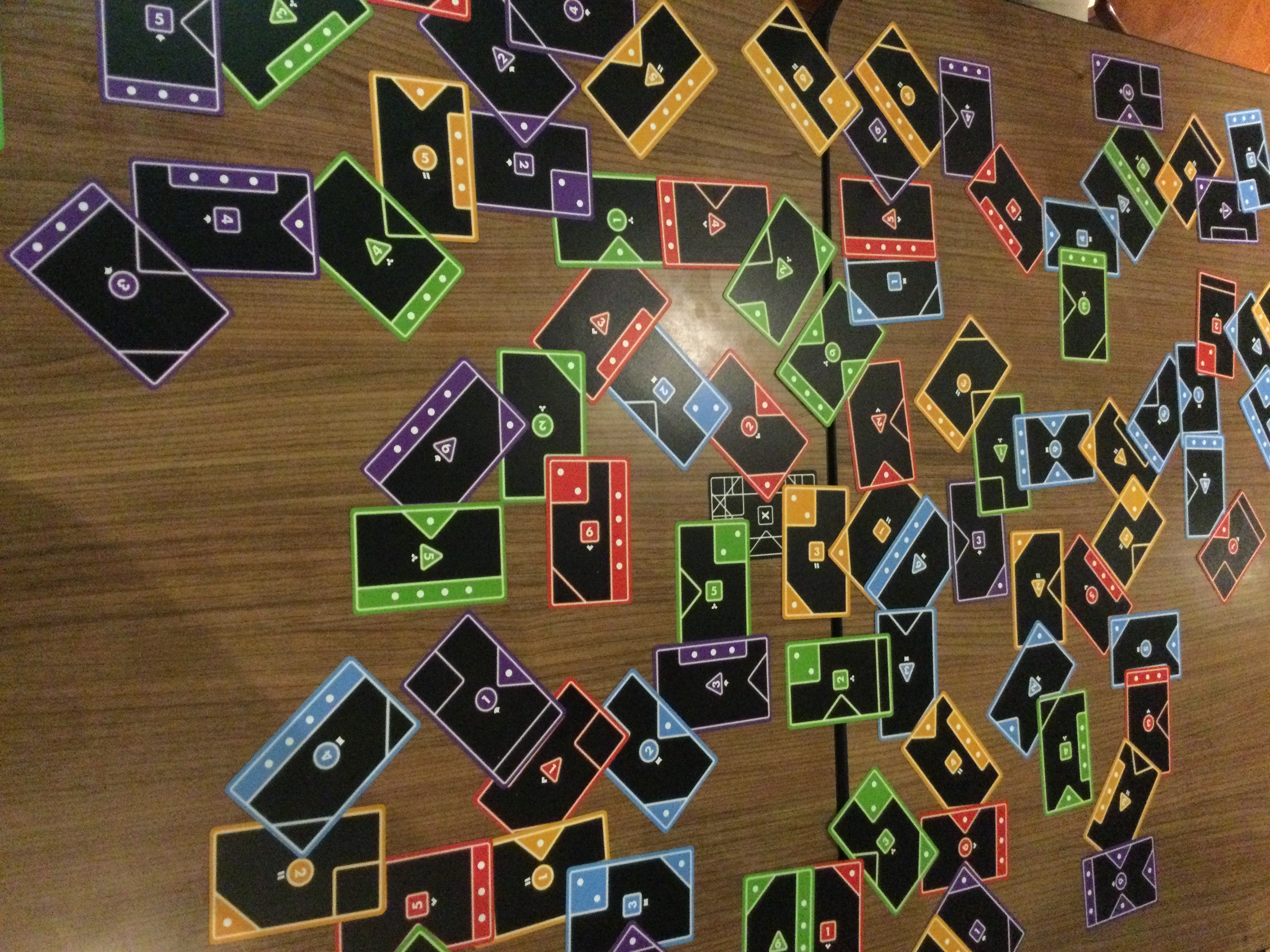
And you thought your work week was busy
Taking one set of expectations from the game with another you find there’s plenty to uncover, discover, and indeed invent yourself with a deck of Tacta. It adds immensely to the replay value of a game that’s already cheap at the price. It can go just about anywhere though it is, once unfurled, a tabletop real estate hog. That in turn can limit playtime though (the edge of the table is the endpoint obviously), which can only be a good thing in a game where boundless opportunities are both Tacta’s greatest strength and weakness.
