
| Publisher | Cocktail Games, Pegasus Spiele |
| Design Credit | Hisashi Hyashi |
| Art Credits | Dominique Ferland, Dom2D |
| Editing Credit | Steven Kimball |
| Game Contents | Components: One board with dial, 17 standard cards (12 Equipment, five Characters), eight large Mission cards, five plastic tile racks, 70 Wire tiles, 40 tokens (26 info, 12 translucent green Validation disks, one equal token, one not-equal token), seven wooden markers (four yellow, three red), five mystery boxes (no spoilers), baggies, Bomb Busters Standee, rules |
| Guidelines | Bomb-busting number deduction game |
| MSRP | $39.95 |
| Reviewer | Andy Vetromile |
When crime is out of control, when lives are on the line, when someone thinks a series of explosives are the best way to get what they want, who do you turn to? That’s right, a group of little cartoon animals dressed in latex body suits with a thirst for living on the edge. Bomb Busters, it’s called, and bust bombs they do.
The object is to defuse – or “bust” – a bomb without cutting the wrong wires.
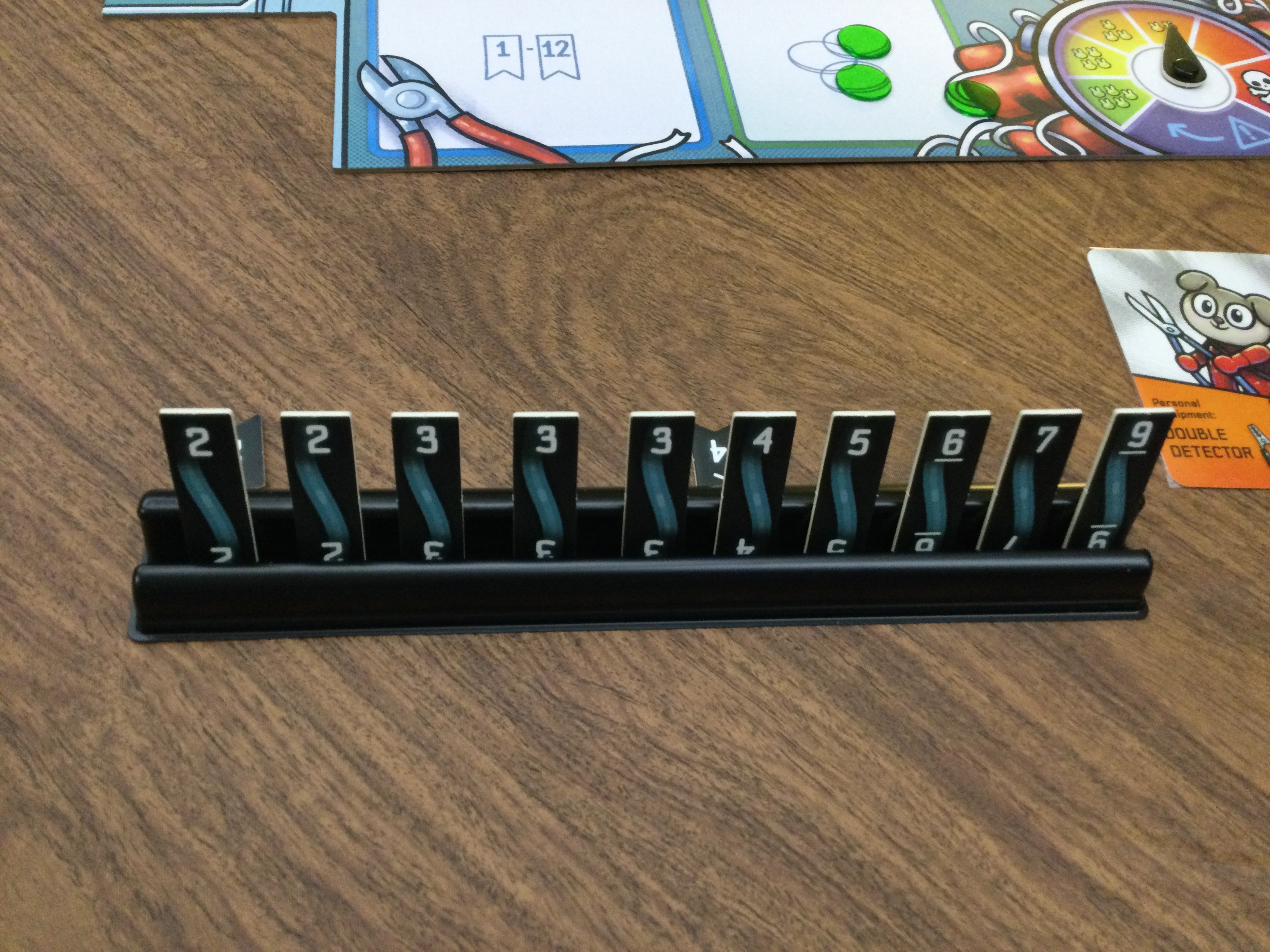
They may not look like wires, but you just try snipping one.
Two to five players take on the role of bomb squad engineers, each equipped with an explosives detector and a lot of hope. And a row of number tiles. Each player gets a rack and fills it in numerical order with the Wire tiles randomly assigned to them. Your coworkers, which seems like an underwhelming way of referring to people with whom you face death every day, can only see their own numbers, but they may each indicate one of these from their selection by placing a smaller matching token in front of it. With the city-destroying ball rolling, players take turns guessing each other’s digits. You may only guess someone’s tiles if you have one of the same tile, i.e., if you want to suggest, “Laura, I think that third tile from my left is a 4,” you can only do so if you have a 4 of your own. If you’re right, you may both take those off your display and put them out front where everyone can see them. There are four of each numeral scattered throughout, permitting some logical leaps as the situation develops (or deteriorates, as circumstances dictate).
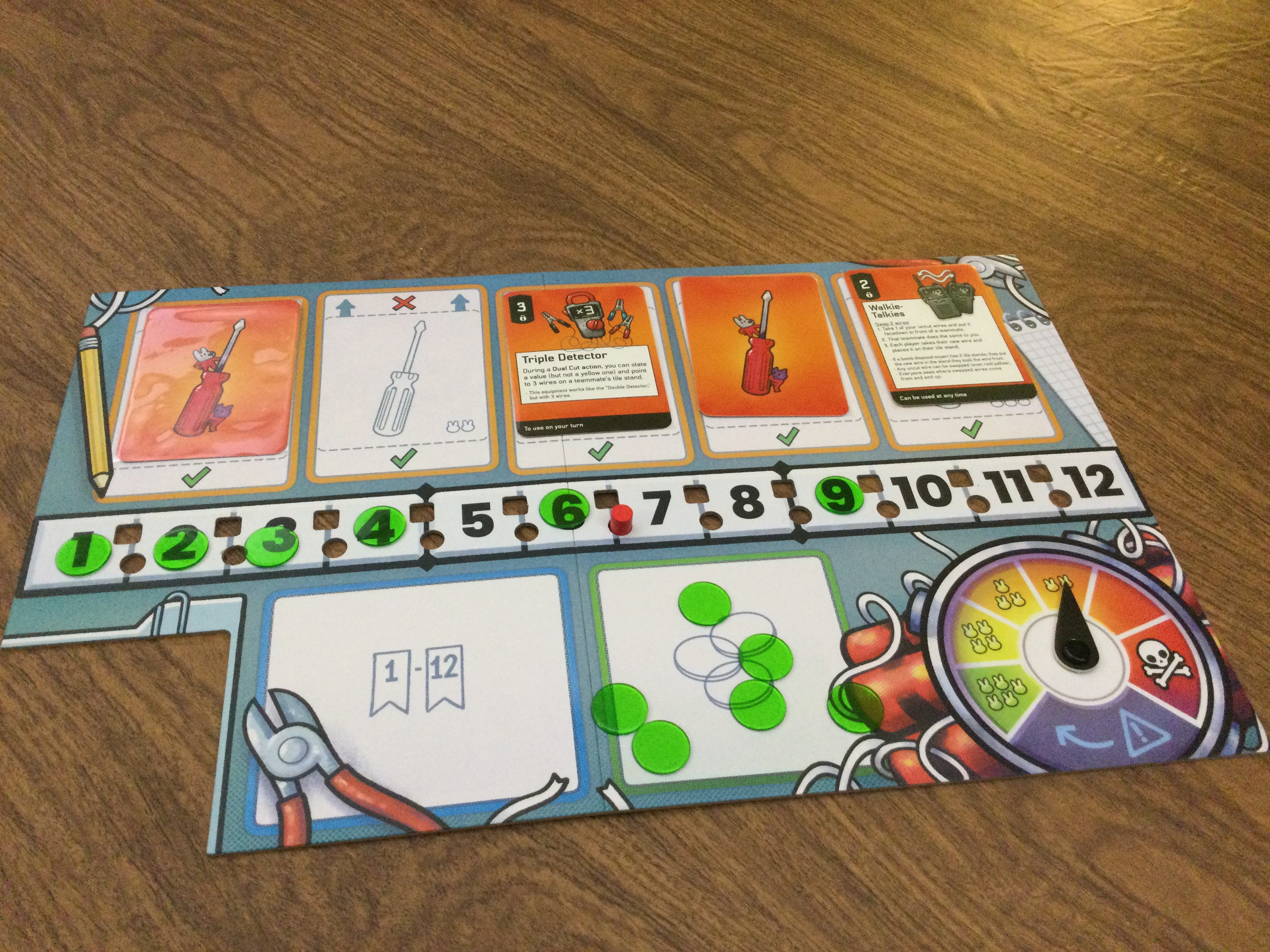
Aren’t you glad you didn’t move the dial? Don’t you wish everyone did?
You may also reveal tiles if you have all of them, or the remainder, though that’s your action for that turn. For example, if you were by chance assigned all the 1s you can expend your action to place them all in plain view. Similarly if two teammates trade off their respective 5s and you have the other two, you can get rid of them on your turn. Fail to deduce correctly and the player identifies the actual value with another little token (but someone still has to spend their turn cutting it later), and the dial on the central board advances one space toward the skull and crossbones (if you’d care to hazard a guess what occurs when that milestone is achieved). Should everyone clear their racks of tokens the good news is the squad succeeds at that mission. The bad news is someone decides to blow up another troubling edifice across town and you have to go back to work the following day – only now it’ll be harder because when do jobs like this ever become easier? More elements are added as Missions progress, like yellow and red wires that don’t just take seconds off the clock, they end the game with an Earth-shattering kaboom.
Your components are mostly good ones, starting with a thick central board where the bulky doomsday clock looks sturdy enough for someone to use it as a Sit ‘n Spin. It’s a colorful display and easy to read (unlike some of the Wire tokens – depending on your eyesight and distance across the table, the numbers may demand some squinting or inquiry). The cards are nice stock as are the various Wire tiles, though the latter are small and often hard to get hold of; it’s also a little too easy to knock some of them over, inadvertantly giving others a generous peep at what you have if you don’t quickly throw yourself over them like a live hand grenade. They need to be fairly vertically slim, though, if you’re going to fit as many of them as you do onto the stands. These personal displays frankly feel a bit thin and cheap to the touch but they work beautifully (so the aforementioned disaster scenario of literally spilling secrets is mostly on you and your dexterity, and less so on your parts). You’re more likely to cock the Wires sideways than release them onto the table, but the rack itself never seems to shift. You get some translucent green discs to cover numbers on the middle board (“That’s the last of the 7s taken care of; don’t guess those any more”); add some distressingly wee little wooden markers and now you can track the dreaded yellow wires, red wires . . . again, this job isn’t getting any easier. The art is cartoony and works for the theme but the Equipment is better executed than the characters.
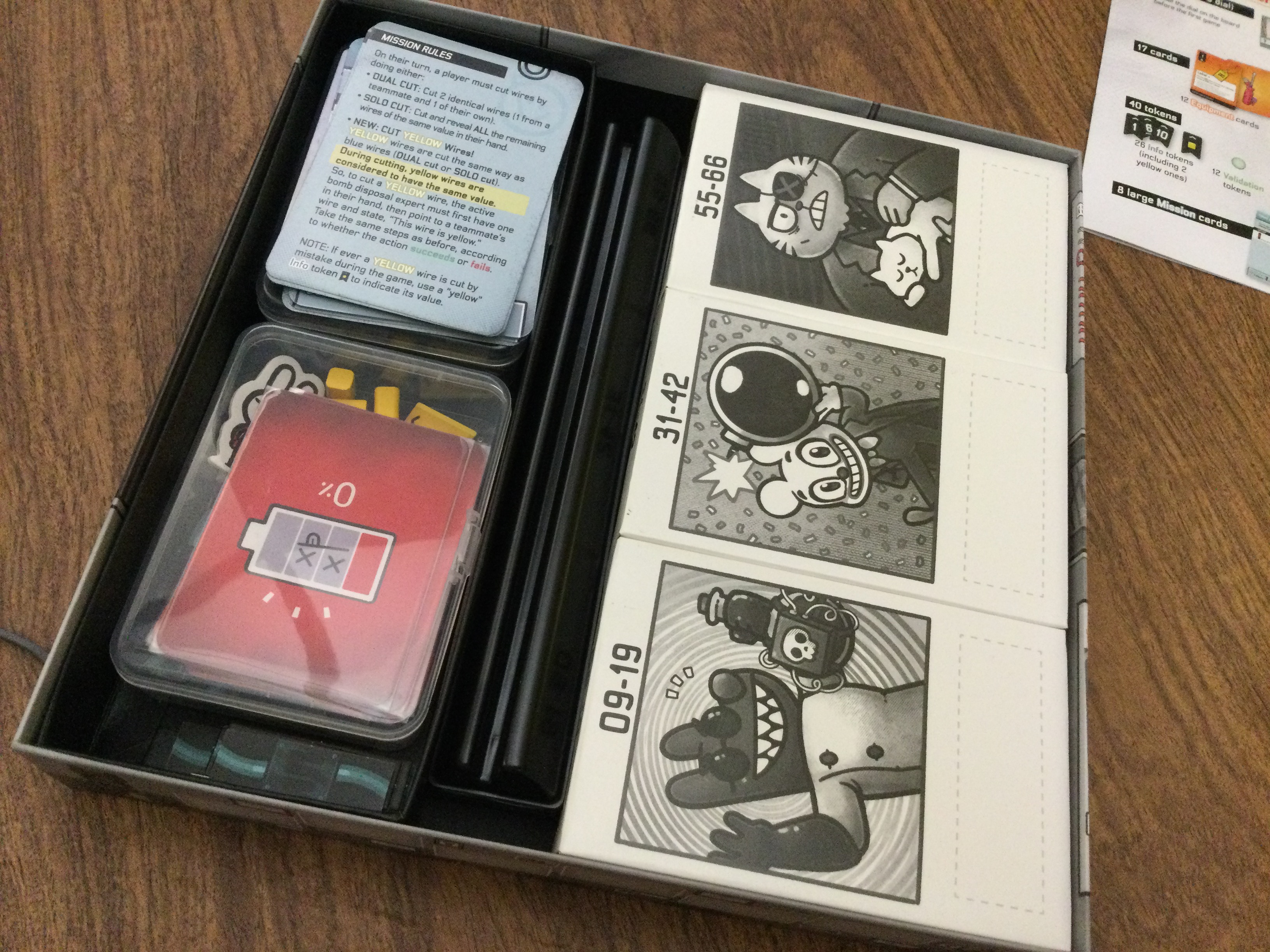
…and when you’ve finished saving downtown, these extra boxes threaten the waterfront. Or something.
And there are more boxes full of fun, rules, twists, and yes, bombs yet to be discovered. You start at 10 sets of numbers but the central track goes to 12 for a reason. Plenty of replay value is offered as one digs into Bomb Busters‘ box and its dozens of Missions. There’s gear to make your job easier, sure, but those are often dependent on your successes during the game to unlock them (why the city is coy about providing the bomb squad with all the tools they need at the outset is anyone’s guess . . . must be a budgeting issue). And that’s the beautiful balancing act the game enjoys. Threats and opportunities ratchet up side-by-side, changing the difficulty levels in tandem, and keeping the defusers on their toes and their heads in the game. New strategies emerge and different solutions must be created to accommodate all these facets of play.
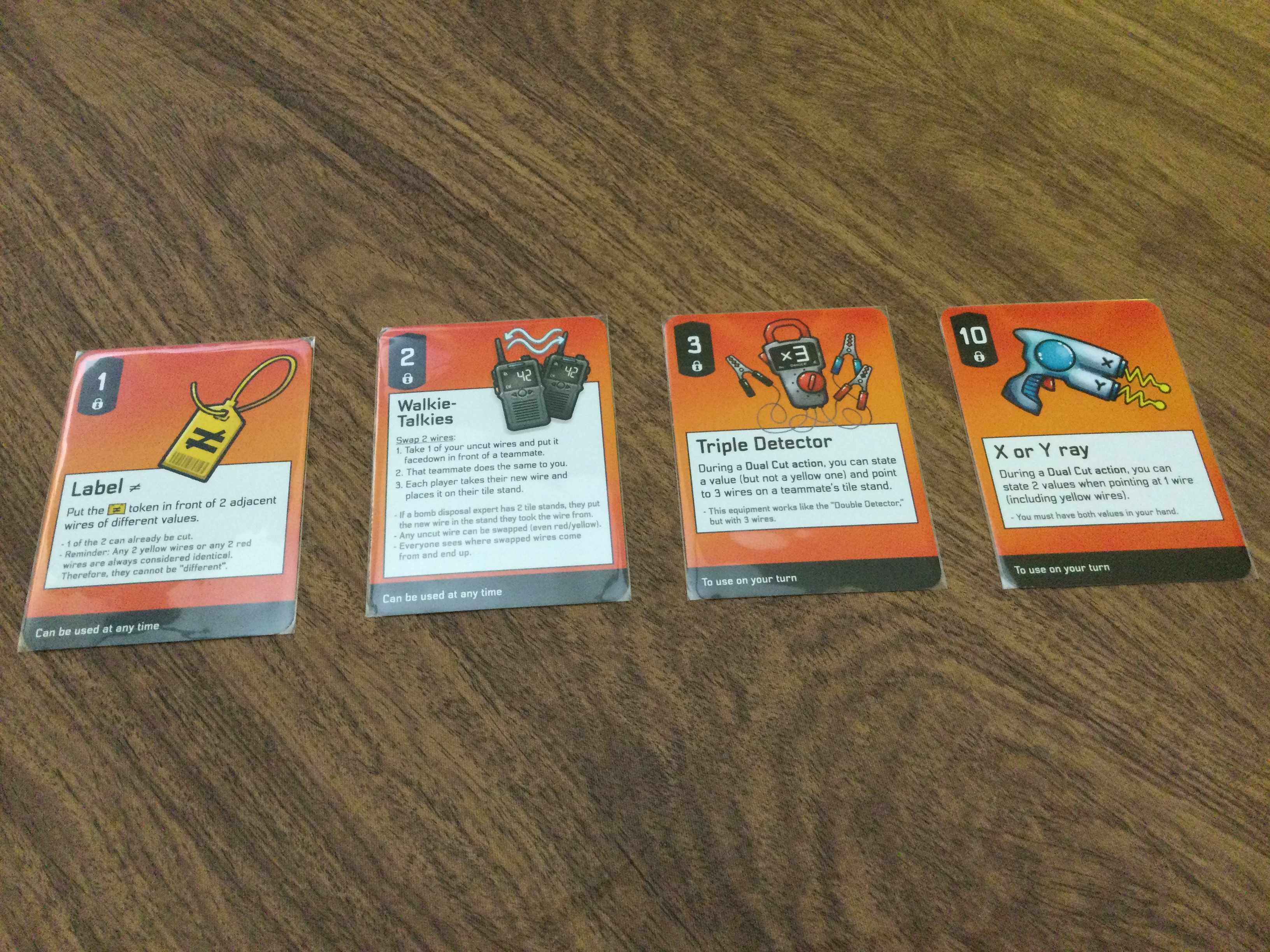
If you do well enough, they may give you a pair of wirecutters.
There can be a lot of tense moments in Bomb Busters; sometimes the choice of actions is obvious and other occasions you find yourself without a clear option, forcing you to think about it or even – heavens – guess. They probably do not rise to the level of tension felt by a real bomb technician in the field but that doesn’t make you wince any less in that brief moment where you make your SWAG and wait to hear if the clock counts off another (last?) precious tick. It’s always fun determining what you’ll reveal at the outset but it doesn’t end there since even in the thick of the trauma pulling out another clue from your rack is a choice not to be made lightly. It could inform everyone at the table or get them all killed – and too often there’s a moment to reflect and think, “Aw, I should have dropped this tile on them; that way they would have known what this other tile indicated.” Bomb defusal isn’t a job where you’d like a lot of surprises but when it lives on your tabletop (and you hope your characters do likewise), Bomb Busters makes threats in the line of duty a blast to play.
